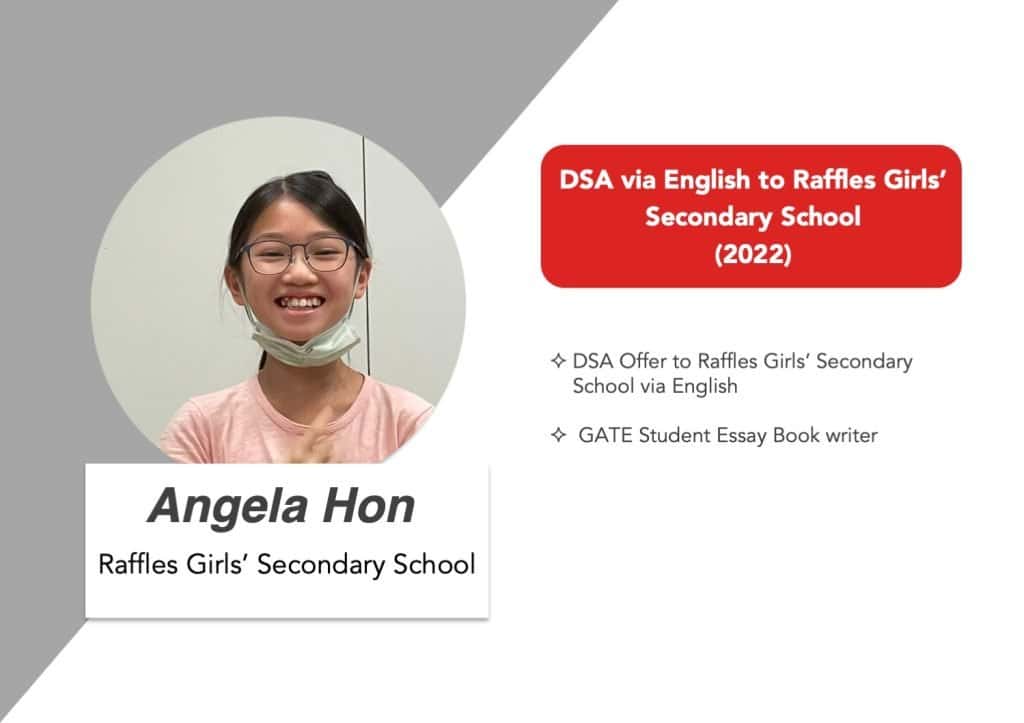
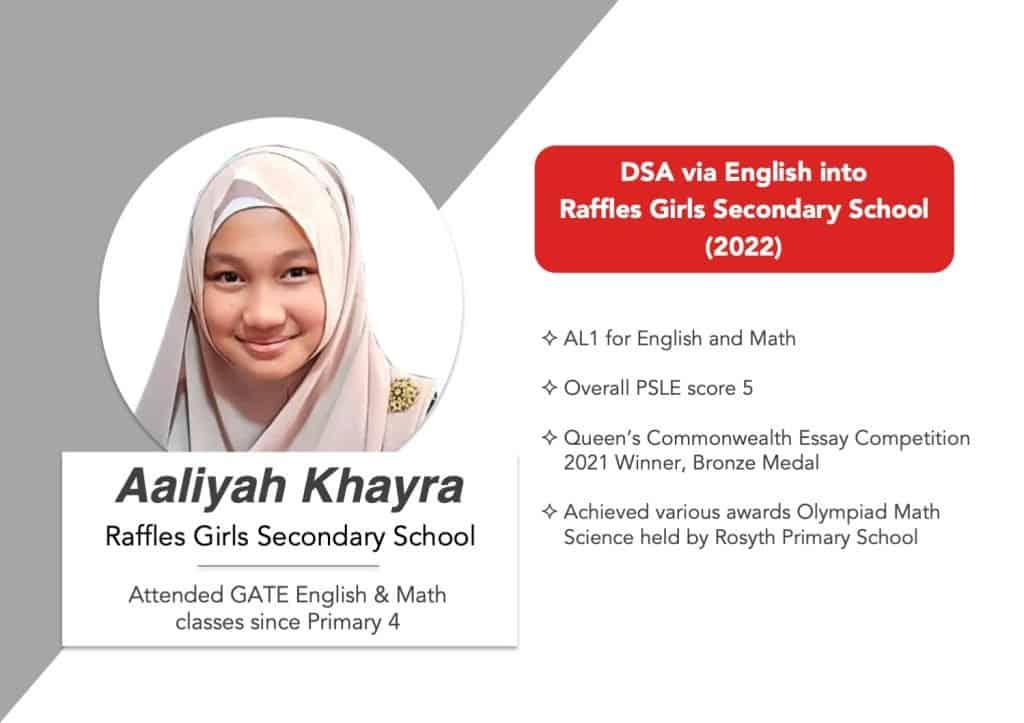
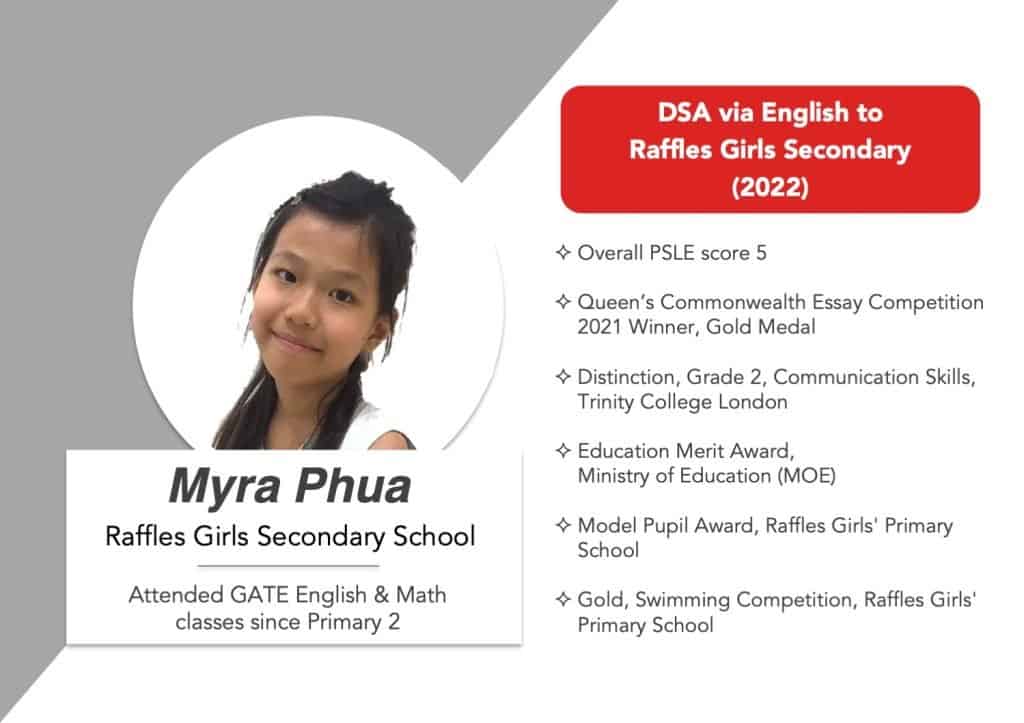
Based on our observation, the #1 trait is READING—everywhere, all the time. Our gifted students don’t just read books; they devour anything with words—school annuals, medical brochures at clinics, instruction manuals—if it has text, they’ll read it!
Here are 5 other standout traits of gifted students: Hyperfocus – Deep obsession with interests, losing track of time. Sharp Humor – Advanced, quirky, or ironic sense of humor. Emotional Intensity – Feels deeply, reacts strongly to injustice. Sensory Sensitivity – Heightened awareness of sounds, textures, and moods. Pattern Recognition – Instantly spots connections in numbers, language, and ideas.
Do you notice these traits in your child? Let us know in the comments!
Get the latest insider analysis in a 5-minute bite-sized read. Every quarter, we’ll dive into the hottest education trends—from college application strategies, DSA’s new domains, to deciding between local or overseas medical schools.
Don’t miss out—subscribe today and stay ahead of the game in your child’s education!
Many parents confuse IP (Integrated Programme), IB (International Baccalaureate), and A Levels. IP is a six-year through-train programme where students skip O Levels and progress directly to a final qualification:
Most IP schools lead to A Levels or IB.
NUS High School, under IP, awards its own NUS High School Diploma.
In short, IP is the pathway, while IB, A Levels, and NUS High School Diploma are the final qualifications.
Now, let’s compare IB and Singapore A Levels in terms of syllabus, grading, university recognition, and suitability for top universities, medical, and law schools.
Key Takeaways:
IB: Best for versatile students aiming for top international unis or law school. Balances STEM and humanities but requires discipline across subjects.
A Levels: Ideal for STEM-driven students targeting medical school. Humanities students can also excel with strong subject choices like H2 English, History, or Literature, though fewer essay-based subjects are available compared to IB.
Choose based on your strengths and career path: IB for adaptability, A Levels for specialisation.
Not sure which path to take? Need help with choosing the most suitable secondary school?
Let us guide you through the journey — from school selection to interview prep.
With a proven track record, we help you choose the right path and prepare a winning application.
Enjoying The 5-Minute Buzz?
Get ready for expert insights, answers to your burning questions, and debunking common myths, like the true value of Olympiad math or the misconception that gifted children can naturally excel without effort.
We’ll deliver the facts, clear up the confusion, and offer practical guides to support your child’s educational journey.
We’re excited to launch our brand-new newsletter, The 5-Minute Buzz! Every quarter, we’ll dive into the hottest education trends—from college application strategies, the debate on whether IB is easier to score than A-levels, and DSA’s new domains, to deciding between local or overseas medical schools. Best of all, The 5-Minute Buzz is packed with engaging updates and insider analysis in a bite-sized read.
Don’t miss out—subscribe today and stay ahead of the game in your child’s education!
Raffles Institution
vs.
Hwa Chong Institution
vs.
NUS High School
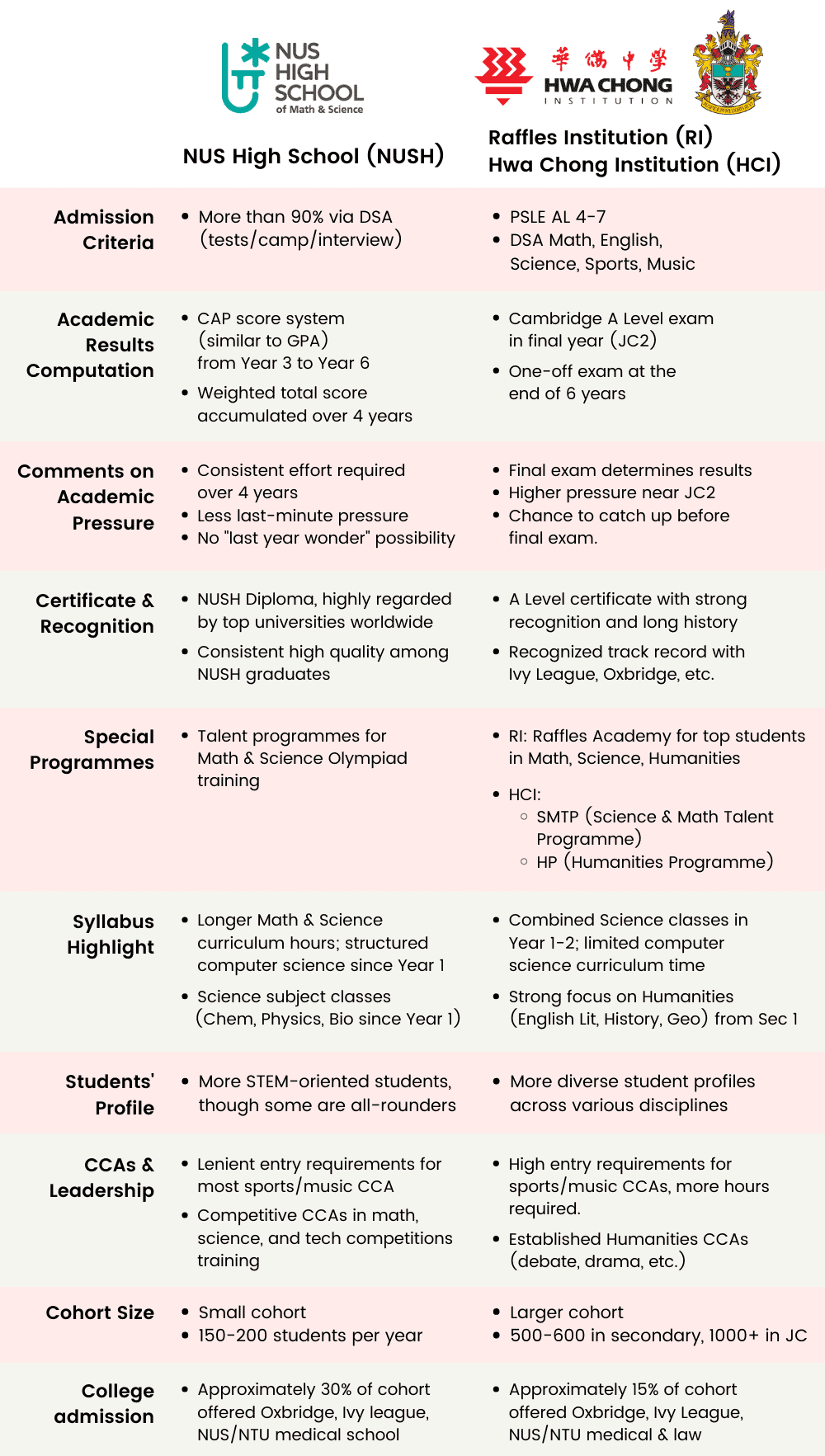
Parents often wonder what the difference is among the top three schools in Singapore. RI (RGS), HCI (NYGH), and NUSH* have the highest record of graduates’ admission to Oxbridge*, Ivy League, and NUS/NTU medical schools. We have been sending our students to these schools for over 10 years. Below is a summary table comparing the three schools. To keep things simple, we focus only on the key differences.
For popular IP schools such as RI and HCI, the PSLE cut-off point ranges from AL4 to AL7. A headstart in learning the syllabus can help the students build a stronger foundation and perform better in their PSLE exams. GATE Math and English programmes are specifically designed for high-ability students who wish to excel in their PSLE and achieve AL1.
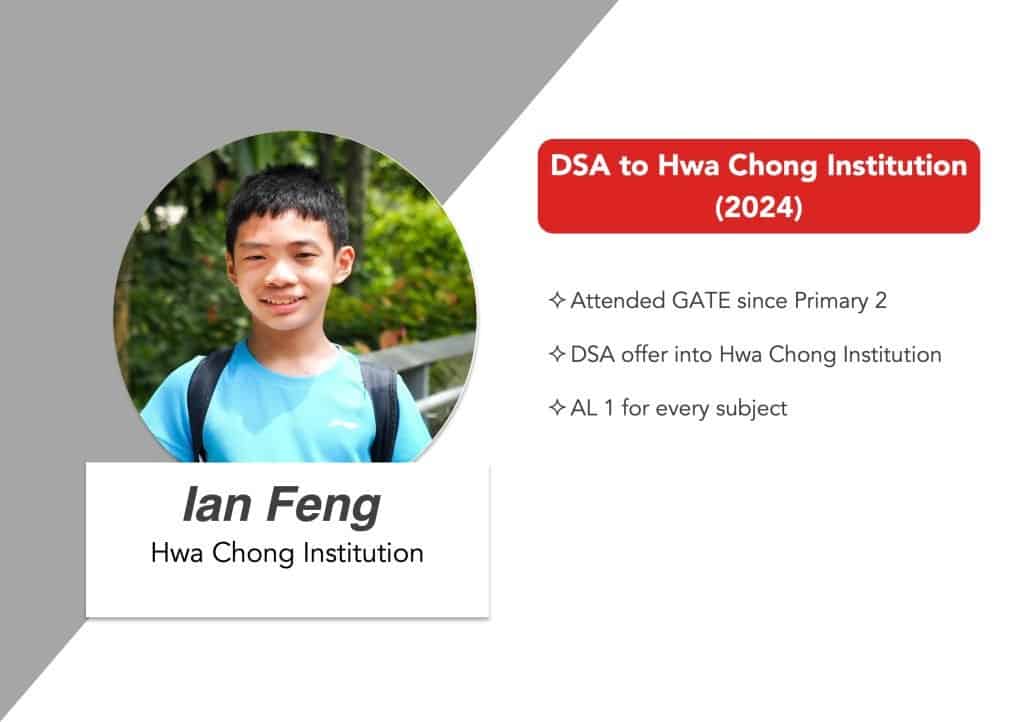
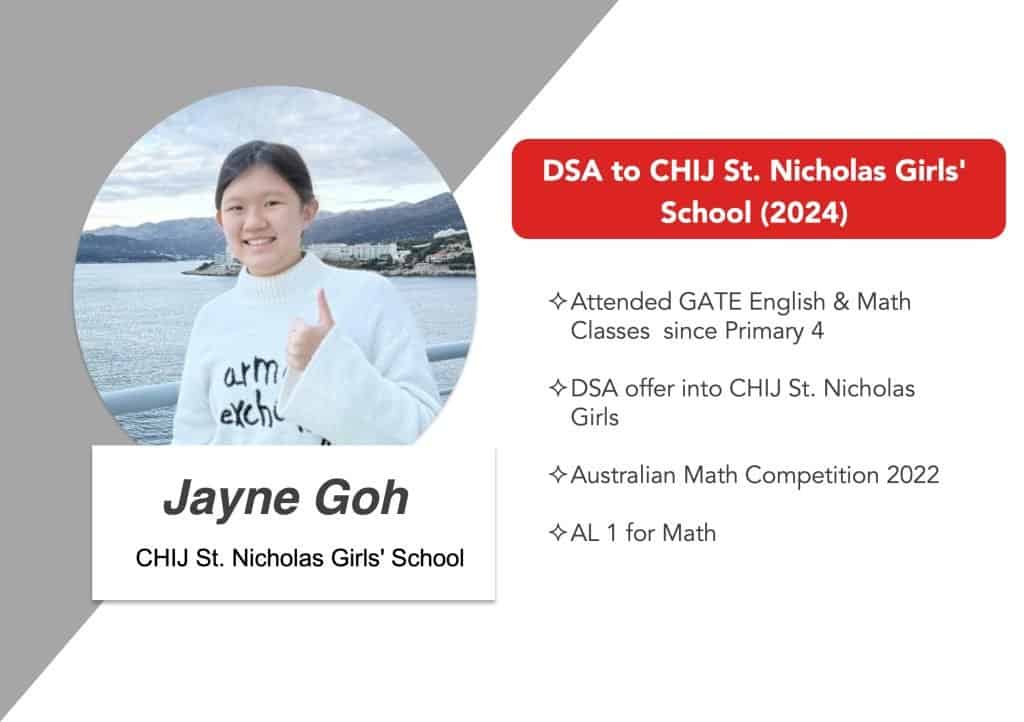
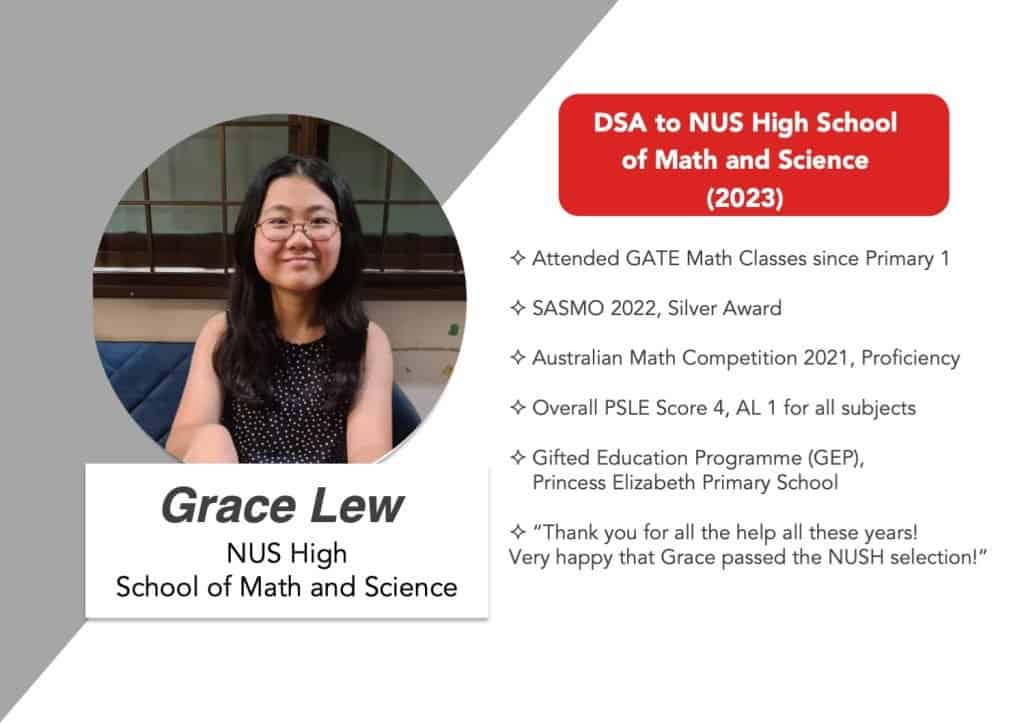
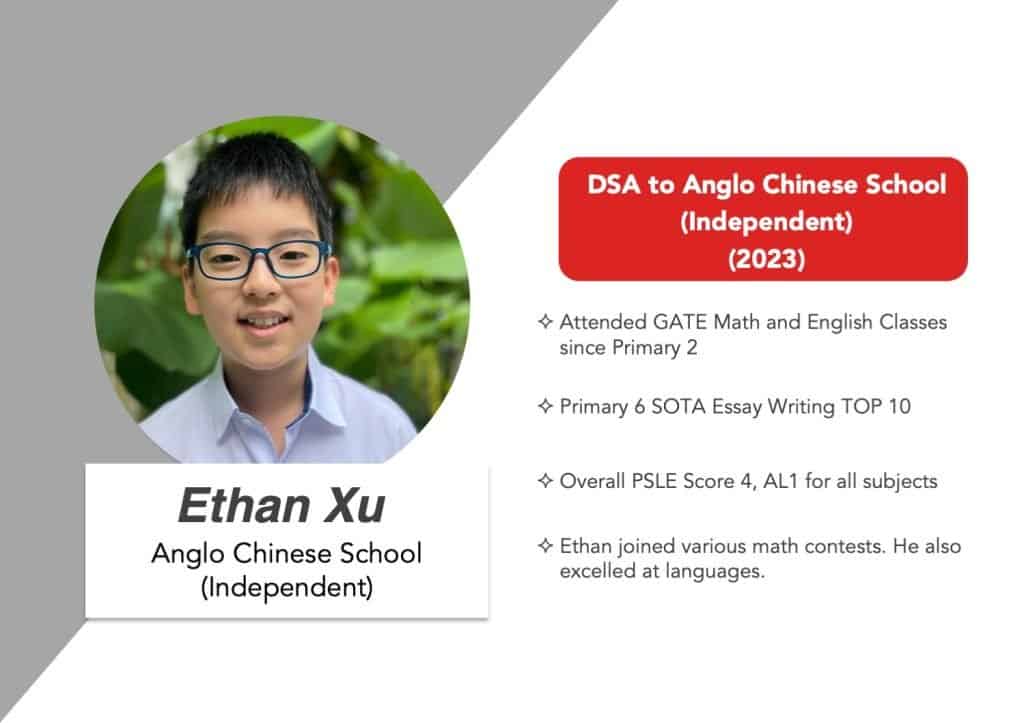
Besides PSLE, most top schools offer comprehensive subject-based Direct School Admission (DSA) options. IP schools like RI and HCI generally admit up to 35% of their Sec 1 IP intake through DSA, while NUS High School of Math and Science admits up to 100% of their Sec 1 intake through DSA.
Join us for our exclusive webinar on 5 March 2025 Wed, 7:30 PM – 8:30 PM, where we uncover the secrets to DSA selection and future pathways. This year, don’t miss a special live case study analysis section of selected students by the GATE Director.
Enjoying The 5-Minute Buzz?
Get ready for expert insights, answers to your burning questions, and debunking common myths, like the true value of Olympiad math or the misconception that gifted children can naturally excel without effort.
We’ll deliver the facts, clear up the confusion, and offer practical guides to support your child’s educational journey.
We’re excited to launch our brand-new newsletter, The 5-Minute Buzz! Every quarter, we’ll dive into the hottest education trends—from college application strategies, the debate on whether IB is easier to score than A-levels, and DSA’s new domains, to deciding between local or overseas medical schools.
Best of all, The 5-Minute Buzz is packed with engaging updates and insider analysis in a bite-sized read.
Don’t miss out—subscribe today and stay ahead of the game in your child’s education!
Summary table of Oxbridge 2023 admission cycle
(Source: UCAS Apply Center 2023 data for University of Oxford & University of Cambridge, JC Official websites)
Over 200 Students Secure Offers from Cambridge and Oxford in the 2023 Admissions Cycle
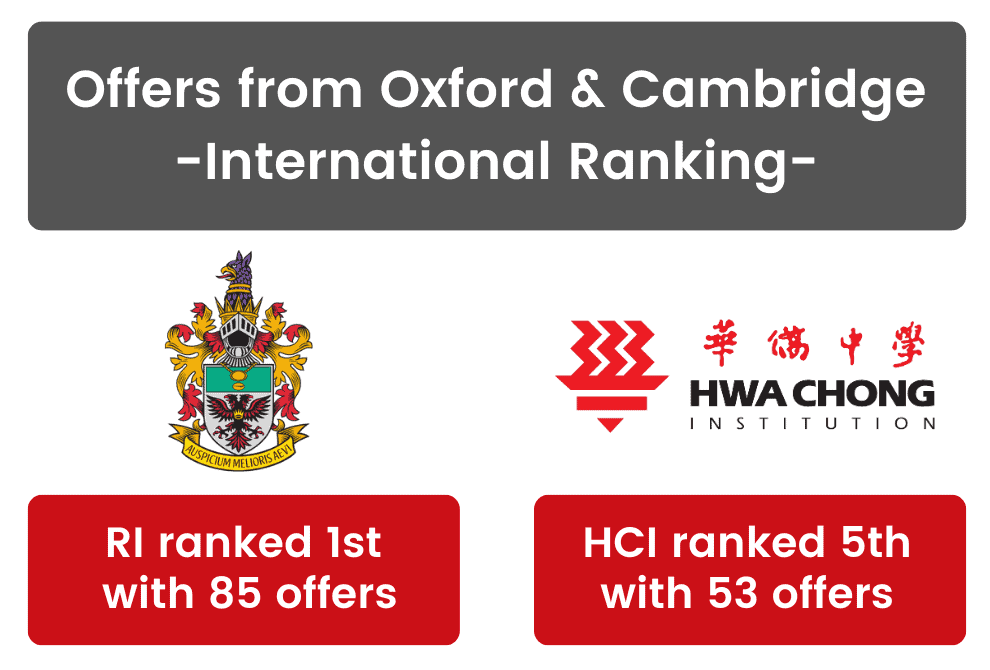
Singapore’s top educational institutions, Raffles Institution (RI) and Hwa Chong Institution (HCI), have once again demonstrated their academic excellence by ranking among the highest in the world for Oxbridge admissions in the 2023 admissions cycle. RI secured first place globally with 85 offers from Oxford and Cambridge, while HCI ranked fifth with 53 offers.
Notably, the NUS High School of Math and Science achieved an impressive 40% acceptance rate, highlighting its strength in preparing students for the competitive environments of top universities. Anglo-Chinese School Independent (ACSI) also performed well, with 23% of its applicants receiving Oxbridge offers.
These results affirm Singapore’s status as a leading educational hub and reinforce that our top public schools are the best bets for parents aiming for Oxbridge success.
Integrated Programme (IP) schools like RI and HCI generally admit around 35% of their Sec 1 IP intake through DSA. Specialised independent schools like NUS High School of Math and Science do not participate in Sec 1 Posting and generally admit up to 100% of their Sec 1 intake through DSA. As a result, Direct School Admission (DSA) has become an increasingly popular option for students seeking to secure a place in their dream school.
To understand more about DSA and work on an education path customised for your child, make a DSA consultation appointment with our founders.
Enjoying The 5-Minute Buzz?
Get ready for expert insights, answers to your burning questions, and debunking common myths, like the true value of Olympiad math or the misconception that gifted children can naturally excel without effort.
We’ll deliver the facts, clear up the confusion, and offer practical guides to support your child’s educational journey.
The Number 1 school in Singapore – RI vs HCI vs NUS High
What do GEP students study? What is the difference between GEP English, Math and Science from mainstream curriculum? What is a typical day of a GEP student?
What is the selection process for GEP? Is it reliable? If my child has a high IQ, will he/she pass the test? What can parents do to prepare their children for the test? Any past year papers?
Part 3–Direct School Admission Interview Top Secret
The DSA interview may seem daunting at first, but with preparation and confidence, your child should be able to ace it.
Q1. Does every school require interviews?
Not all schools will require interviews. There are other means of assessing your child’s suitability, such as admission tests and camps.
There are two types of interviews: the solo interview and the group interview.
Q2. What are some interview questions to expect?
You can expect routine questions
the applicant’s strengths, weaknesses, personality
the applicant’s portfolio/academic track record/achievements
the applicant’s potential to contribute to the DSA school based on applicant’s experience and opinions
the school’s programmes and motivation for choosing the school
Non-routine questions
the applicant’s reasoning process
the applicant’s ability to think on the spot and handle surprise
General knowledge, current affairs question
Questions about general knowledge and whether applicant can apply them
Questions about social issues and current affairs
(For group interviews) Interviewers also look out for the interactions between the applicants and problem-solving skills.
Q3. If my child applied DSA based on his or her exceptional talent in mathematics, will there be math theory related interview questions?
This would depend on the school. Some applicants were asked math-related interview questions. However, some were asked about current affairs issues that were not related to math.
Q4. What do interviewers expect from their applicants?
Interviewers may be looking out for: strong communication skills, confidence, ability to adapt to unexpected events and whether applicant can value-add to the domain he or she specialises in.
Body language is also important: your child should sit up straight, maintain the right posture and maintain eye contact with interviewer.
Q5. In a group interview, how vocal/outspoken my child should be?
when it is your child’s turn, he or she should answer with confidence.
When it is not your child’s turn, do not attempt to answer the question unless the student cannot handle the question and the interviewer has indicated the rest of the students in the room can answer.
Being overly aggressive may create the impression that your child is not a team player.
Q6. How can we prepare our child for the interview?
For routine questions:
Draft a short pitch and get your child to memorise.
Keep practicing until it becomes natural.
Don’t focus on something too cliché or common. For example, many applicants do play the piano or have activities such swimming. Instead of providing too much details about your general achievements, you should highlight something unique about you to distinguish yourself from others.
For non-routine questions:
Exposure to current affairs is crucial. You can engage your child in current affairs by having light conversations over dinner or reading newspaper articles with them.
Q7. Do we need to enrol our child for any special DSA preparation programmes found in the tuition centres?
Gifted and Talented Education offers programmes such as Classroom to Boardroom which focuses on communication skills and critical reasoning process. We also conduct DSA interview camps to help students manage the interview process effectively. The DSA Interview is likely to be the first interview in your child’s life. Sufficient preparation and warm up exercises will make a huge difference.



 Hyperfocus – Deep obsession with interests, losing track of time.
 Sharp Humor – Advanced, quirky, or ironic sense of humor.
 Emotional Intensity – Feels deeply, reacts strongly to injustice.
 Sensory Sensitivity – Heightened awareness of sounds, textures, and moods.
 Pattern Recognition – Instantly spots connections in numbers, language, and ideas.